Safety: Advanced Imaging Technology is safe and meets national health and safety standards. This technology uses non-ionizing radio-frequency energy in the millimeter spectrum with no known adverse health effects. It does not use X-ray technology.
Privacy: TSA has strict privacy standards when using Advanced Imaging Technology to protect your privacy. Advanced imaging technology uses automated target recognition software that eliminates passenger-specific images and instead auto-detects potential threats by indicating their location on a generic outline of a person. The generic outline is identical for all passengers.
BWI Marshall Airport works in close partnership with the Transportation Security Administration (TSA) to ensure safe travel for all BWI Marshall Airport passengers.
For additional information see: TSA Website
Be Prepared for Increased Wait Times During Peak Travel Times
| |
Saturday |
Sunday |
Monday |
Tuesday |
Wednesday |
Thursday |
Friday |
| AM |
6:00 - 8:00 |
6:00 - 8:00 |
5:00 - 8:00 |
6:00 - 8:00 |
6:00 - 8:00 |
5:00 - 8:00 |
5:00 - 8:00 |
| PM |
1:00 - 2:00 |
4:00 - 7:00 |
3:00 - 6:00 |
3:00 - 5:00 |
4:00 - 5:00 |
3:00 - 7:00 |
3:00 - 5:00 |
Know the 1 + 1 Rule for Your Carry-On Bags
You are allowed one (1) carry-on bag and one (1) personal item. Your items must fit below the seat in front of you or in an overhead bin. Your carry-on bag should not exceed 22 x 14 x 9 inches / 23 x 36 x 56 centimeters (including handles and wheels). A personal item must be smaller than your carry-on bag (like a small purse, briefcase or laptop). Diaper bags, child safety seats, and medical or mobility devices do not count as your carry-on or personal item. Please check with your respective airline as they may further restrict allowable size. Musical instruments are also considered a carry-on item and must fit in the overhead bin or under the seat in front of you.
In addition, when traveling with a pet, the kennel or container counts as your carry-on bag and the carry-on pet fee also applies.
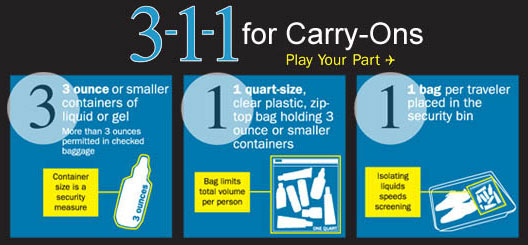
3-1-1 for carry-ons: 3.4-ounce (100-milliliter) bottle or less (by volume) - one (1) quart-sized, clear, plastic, zip-top bag - one (1) bag per passenger placed in screening bin; one (1) quart-sized bag per person limits the total liquid volume each traveler can bring. The 3.4-ounce (100-milliliter) container size is a security measure.
Consolidate bottles into one bag and X-ray separately to speed screening. Be prepared. Each time TSA searches a carry-on it slows down the line. Practicing 3-1-1 will ensure a faster and easier checkpoint experience. If in doubt, put your liquids in checked luggage.
Declare larger liquids. Medications, baby formula and food, breast milk, and juice are allowed in reasonable quantities exceeding three ounces and are not required to be in the zip-top bag. Declare these items for inspection at the checkpoint.
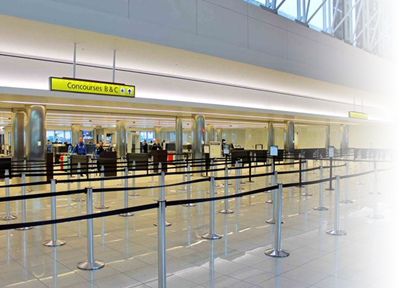
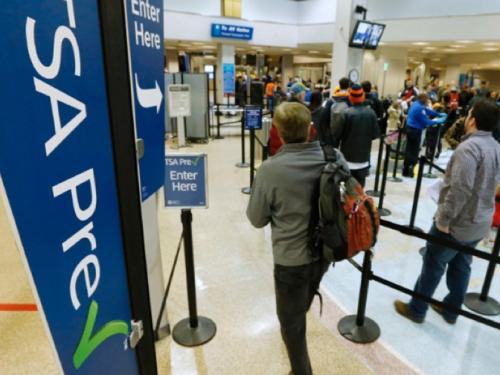
Come early and be patient. Heavy travel volumes and the enhanced security process may mean longer lines at security checkpoints. TSA working with our partners. TSA works with airlines and airports to anticipate peak traffic and be ready for the traveling public.
There are many items that are prohibited, some in carry-on and some in carry-on and checked baggage. For details about the new security procedures and time saving tips visit the TSA Website.
Canine Units
TSA passenger screening canine teams may be operationally deployed at the airport, especially near checkpoints. The canines are working animals that are trained to detect traces of explosives concealed on passengers or their belongings. Passengers traveling with pets are asked to use a checkpoint where the working dogs are not assigned at a particular time. Passengers traveling with service animals may continue to use the checkpoint with working dogs.